

Popular articles








The Kalshi Revolution: How a Federal Loophole Reimagined Wagering in the U.S.
In a landscape heavily fractured by state-by-state gaming laws, a new financial behemoth has quietly rewritten the rules of speculation. Kalshi, a U.S.-based prediction market founded in 2018 by MIT classmates Tarek Mansour and Luana Lopes Lara, has exploded into the mainstream. It isn't a sportsbook. It isn't an offshore casino.
Instead, Kalshi presents itself as an exchange where users trade event contracts tied to real-world outcomes. Whether it is predicting election results, economic inflation data, or the final score of a Sunday night football game, the platform allows users to capitalize on their foresight. But with its rise comes a wave of regulatory scrutiny and consumer confusion.
Here is the definitive guide to how Kalshi works, the debate over its classification as gambling, and why it legally operates in the notoriously strict jurisdictions of California and Texas.
How Does Kalshi Work? The Mechanics of Event Contracts
At its core, Kalshi strips away the complexity of traditional derivatives and replaces them with a radically simple premise: "Yes" or "No" questions.
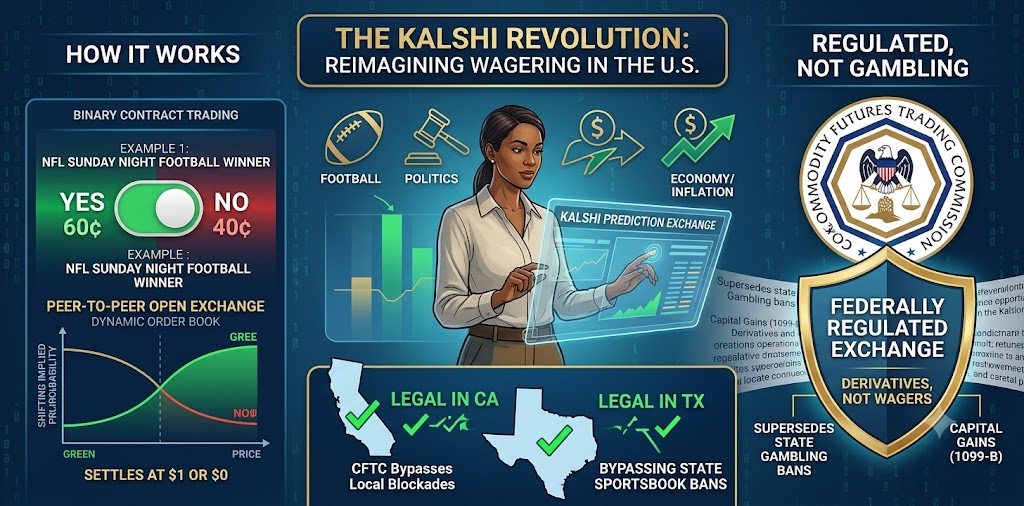
Unlike a sportsbook where bettors wager against the "house" and deal with built-in profit margins (the vig), Kalshi operates as a peer-to-peer open exchange. You are trading against other humans.
Here is the exact data-driven breakdown of how trading works on the platform:
- The Implied Probability Model: Every contract on Kalshi is priced in cents, ranging from $0.01 to $0.99. These cents directly correlate to the market's implied probability of an event happening. If a "Yes" contract for a specific political outcome costs 60 cents, the collective market believes there is a 60% chance that event will occur.
- The $1 Settlement: When an event is officially resolved, the winning contract automatically settles at exactly $1.00, while the losing side drops to $0.00. If you bought in at 60 cents and the event happens, you profit 40 cents per contract.
- Limit Orders & Early Exits: Because it is a dynamic order book, users aren't forced to take the posted odds. Traders can set limit orders to demand a better price. Furthermore, users can sell their contracts before an event concludes to lock in profits or mitigate losses as the real-time probabilities shift.
Is Kalshi Gambling? The Federal Regulation Shield
The most frequent question surrounding the platform is one of classification. Is trading on a sports outcome on Kalshi actually gambling?
Legally speaking, the answer is a definitive no.
Kalshi is federally registered as a Designated Contract Market (DCM). This means it is directly regulated by the Commodity Futures Trading Commission (CFTC)—the exact same federal agency responsible for overseeing multi-trillion-dollar U.S. derivatives and futures markets.
By classifying event outcomes as "commodities" and the wagers as "event contracts," the platform circumvents the traditional definition of sports betting. When you use a sportsbook, you are participating in a state-regulated gambling activity. When you use Kalshi, you are executing a financial trade on a federally regulated commodity exchange. Consequently, Kalshi users typically receive a 1099-B tax form for capital gains, rather than the W-2G form associated with traditional casino or sportsbook winnings.
Also read:
- Is Kalshi Legit? A Deep Dive into America’s Regulated Prediction Market (2026)
- Kalshi Sues Illinois Over 15% Prediction Market Tax in Escalating Jurisdiction War
- Beyond Willpower: Inside the Clinical Treatment of Gambling Addiction
The State Battleground: Is Kalshi Legal in California and Texas?
Because traditional sports betting is legislated at the state level, millions of Americans have been locked out of the market. Kalshi’s federal backing allows it to bypass these local blockades.
Is Kalshi Legal in California?
Yes. California is notoriously one of the largest states without legal online sports betting. Efforts to legalize sportsbooks have repeatedly failed due to intense conflicts with tribal gaming groups, who hold exclusive rights under the Indian Gaming Regulatory Act (IGRA).
Recently, federally recognized California tribes attempted to shut Kalshi down in federal court, arguing its sports event contracts infringed on their exclusive IGRA rights. A federal judge ruled in Kalshi's favor, declining to issue an injunction. Because Kalshi is a CFTC-regulated financial exchange, it supersedes state-level tribal gambling monopolies. Eligible Californians (18+) can freely trade on the platform today.
Is Kalshi Legal in Texas?
Yes. Similar to California, Texas maintains strict anti-gambling laws that outright ban traditional mobile sportsbooks like DraftKings or FanDuel. However, because Kalshi operates under the federal oversight of the CFTC, it does not require approval from the Texas state legislature or a state gaming commission. It is fully accessible to Texans, who use the platform to legally trade on sports, politics, weather, and cryptocurrency events.
Why is Kalshi legal where sports betting isn't?
Kalshi is governed by federal commodities law, not state gaming law. Because it is categorized as a financial derivatives exchange by the CFTC, it legally bypasses state-level gambling restrictions that block traditional sportsbooks.
Is Kalshi better than a sportsbook?
It depends on the trader. Because Kalshi is a peer-to-peer exchange, there is no "house edge." Highly skilled value bettors often compare Kalshi's implied probabilities against traditional sportsbook odds, exploiting the gaps to find superior payout numbers. However, Kalshi is strictly limited to Yes/No binary outcomes, meaning it lacks the vast parlay and prop-betting infrastructure found on dedicated sportsbooks.
Subscribe to unlock premium content
Sed at tellus, pharetra lacus, aenean risus non nisl ultricies commodo diam aliquet arcu enim eu leo porttitor habitasse adipiscing porttitor varius ultricies facilisis viverra lacus neque.