
Popular articles






You made money on Kalshi or Polymarket. Now what?
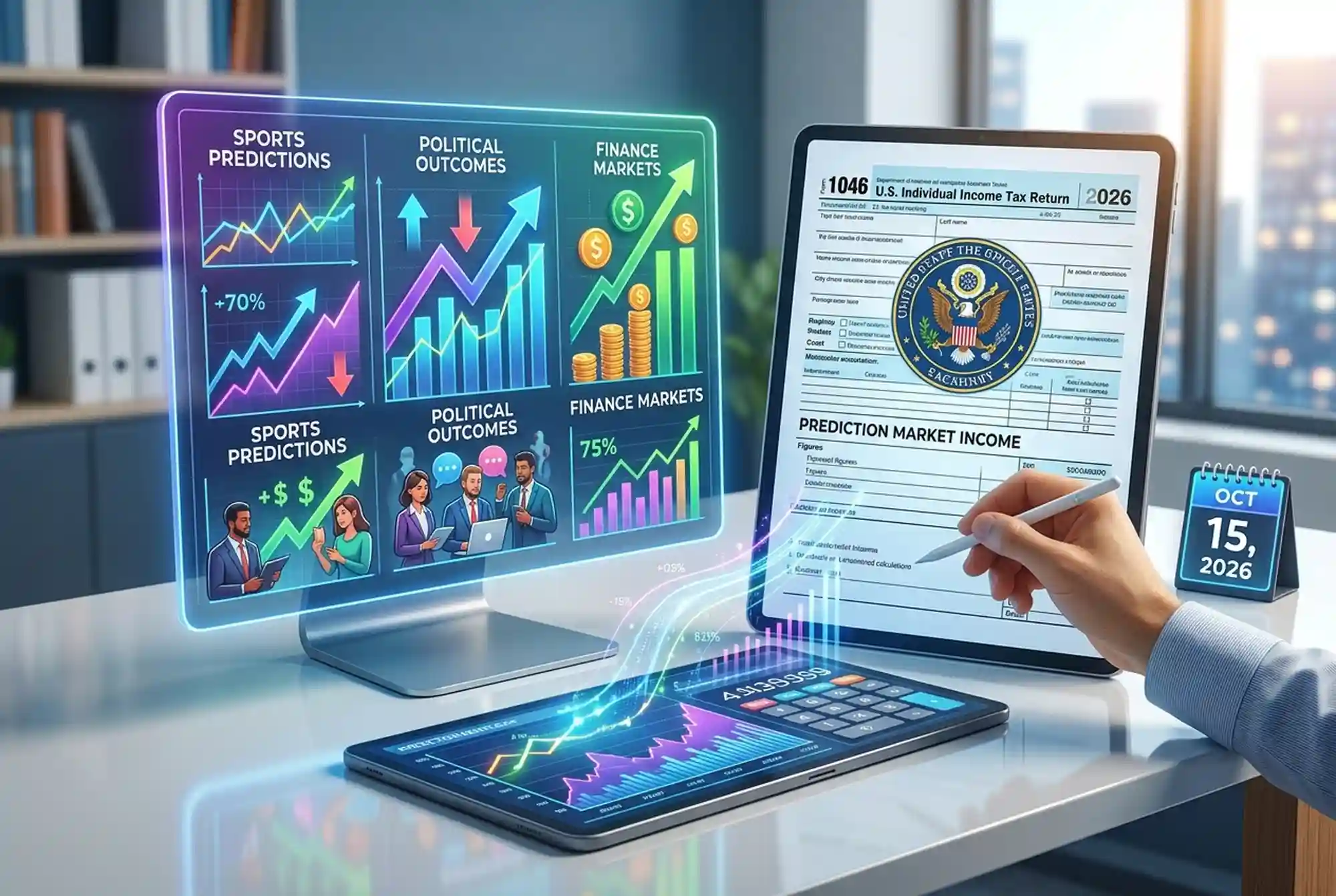
Here's the uncomfortable truth: as of 2026, the IRS has issued zero specific guidance on how to tax prediction market income. No ruling, no notice, no regulation. That leaves traders navigating a grey zone between three very different tax treatments — with meaningfully different outcomes for your tax bill.
This guide breaks down what we know, what's contested, and what you need to do right now to stay out of trouble. One disclaimer upfront: this is not tax advice. Given how unsettled this area is, a CPA familiar with financial derivatives and crypto is worth their fee here. But understanding the landscape yourself is the first step.
The Honest Answer: It Depends on the Platform and How You Trade
Prediction market income doesn't fit neatly into existing IRS categories — because the IRS hasn't decided where it fits. Depending on how your contracts are classified, you could be looking at:
- Short-term capital gains (ordinary income rates, up to 37%)
- Long-term capital gains (0%, 15%, or 20%)
- Section 1256 treatment (60% long-term / 40% short-term regardless of holding period — the most favorable option)
- Gambling income (the least favorable, with strict loss deduction limits)
The platform you use and the structure of your trades influence which treatment applies. Let's walk through each one.
Option 1: Capital Gains Treatment (The Most Common Approach)
Most tax professionals currently treat prediction market contracts as capital assets, which means profits and losses flow through Schedule D and Form 8949 — the same forms you'd use for stocks or ETFs.
How it works:
- Buy a contract → sell it or let it resolve → calculate gain or loss
- Hold the contract less than a year → short-term capital gain, taxed at ordinary income rates (10%–37%)
- Hold a contract more than a year → long-term capital gain (0%, 15%, or 20%)
In practice, most prediction market contracts resolve in days, weeks, or months — so almost all prediction market income ends up as short-term capital gains, taxed at whatever your ordinary income bracket is.
Tracking requirement: You need to record every trade — purchase price, sale price, date opened, date closed. Kalshi issues Form 1099-B (the standard broker form), which helps significantly. Polymarket issues no 1099s, so tracking is entirely on you.
Losses: Capital losses can offset capital gains dollar-for-dollar. If you have more losses than gains, you can deduct up to $3,000 against ordinary income per year, carrying the rest forward.
Option 2: Section 1256 — The Favorable Treatment Traders Are Hoping For
Section 1256 of the Internal Revenue Code covers specific types of financial contracts — primarily regulated futures contracts and foreign currency contracts — and grants them a significant tax benefit: the 60/40 rule.
Under Section 1256:
- 60% of gains are treated as long-term (regardless of how long you held the contract)
- 40% of gains are treated as short-term
- Contracts are marked to market at year-end (you report unrealized gains/losses as if you sold everything on December 31)
- You can carry back losses up to 3 years to offset prior Section 1256 gains
For a trader in the 37% bracket, the blended Section 1256 rate on net gains works out to roughly 26.8% — compared to 37% under straight short-term capital gains treatment. That's a substantial difference on meaningful profits.
Does Section 1256 Apply to Prediction Markets?
This is the central tax question — and it's genuinely contested.
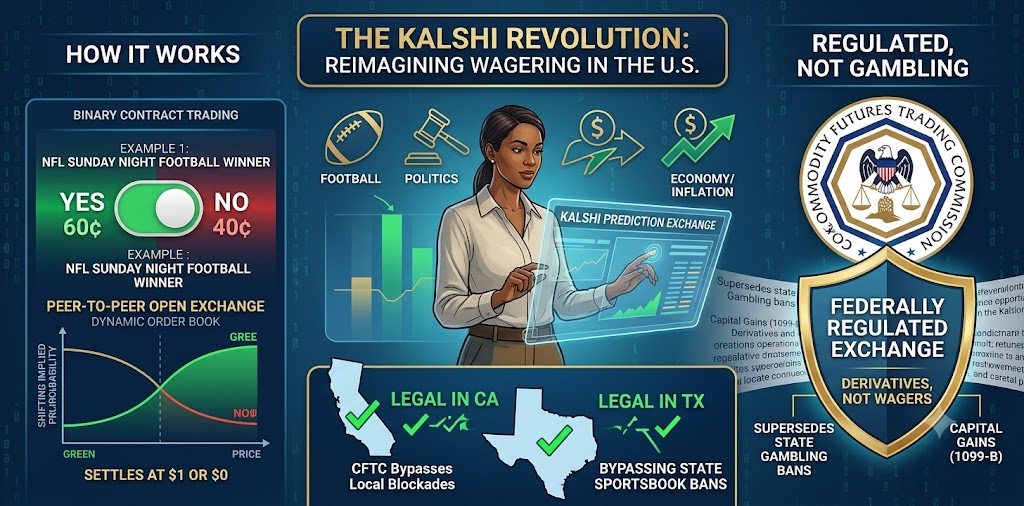
The argument for: Kalshi is a CFTC-regulated exchange, and its contracts are designated as "event contracts" under the Commodity Exchange Act. Some tax professionals argue this makes them "regulated futures contracts" qualifying for Section 1256. If that argument holds, Kalshi traders could file on Form 6781 instead of Schedule D.
The argument against: The CFTC may classify event contracts as "swaps" rather than futures — and swaps are explicitly excluded from Section 1256. The IRS hasn't confirmed either interpretation, and without explicit IRS guidance, claiming Section 1256 treatment on Kalshi contracts carries audit risk.
The bottom line: Some traders and CPAs are claiming Section 1256 on Kalshi positions. Others are taking the more conservative capital gains route and waiting for IRS clarity. If you want to claim Section 1256 treatment, work with a tax professional who can document the legal reasoning and defend it if challenged.
Option 3: Gambling Income — And Why It's Often the Worst Choice
Some tax professionals classify prediction market contracts as gambling income, reporting it on Schedule 1 as "other income." This might seem like a simple path, but the tax math is often brutal.
The 2026 §165(d) problem: Under current rules, wagering losses can only be deducted up to the amount of wagering gains — and a 2026 rule now caps that deduction at 90% of losses. This creates phantom income: even a breakeven year on prediction markets could result in a taxable gain on paper.
Here's an example:
- You place 100 trades, winning $10,000 on winners and losing $9,000 on losers
- Net profit: $1,000
- Under gambling rules, you might report $10,000 in gains but can only deduct $8,100 in losses (90% of $9,000)
- Taxable gambling income: $1,900 — nearly double your actual profit
For professional gamblers (those whose primary income comes from wagering), the rules are somewhat different — you can deduct ordinary business expenses — but self-employment tax (15.3%) kicks in on net earnings.
The professional gambler test: The IRS uses the Commissioner v. Groetzinger standard: trading must be your primary occupation, conducted full-time, with intent to profit. Casual or part-time prediction market traders won't qualify.
Unless a tax professional specifically recommends gambling treatment for your situation, capital gains classification is generally more favorable.
Is Kalshi Legit? The 2026 Prediction Market's Battle Over CFTC Regulation and Legal Status
Polymarket: The Crypto Complication
Polymarket adds a layer of complexity that trips up a lot of traders: it settles in USDC, a USD-pegged stablecoin — and under IRS Notice 2014-21, cryptocurrency (including stablecoins) is treated as property, not currency.
This creates a potential chain of taxable events:
- Converting USD to USDC — if USDC ever trades above or below $1.00 when you convert, that's a taxable gain or loss (usually minimal, but technically required)
- Trading event contracts — gains and losses on the contracts themselves
- Converting USDC back to USD — if the exchange rate differs from when you acquired the USDC, another potential gain or loss
In practice, most USDC conversions are close enough to $1.00 that the crypto gains/losses are negligible. But the main point stands: Polymarket trading involves cryptocurrency, and the IRS expects you to track and report it as such.
Polymarket issues no 1099 forms. Every trade, every wallet transaction, every conversion is your responsibility to track. Tools like Koinly, CoinTracker, and TaxBit can help automate this by connecting to your wallet's transaction history.
What Forms Do You File?
Even when a platform issues a 1099-B, review it carefully. Platforms may not have your cost basis correctly calculated if you've transferred contracts between wallets or accounts. You're responsible for the accuracy of your return, not the platform.
Do Wash Sale Rules Apply?
Wash sale rules (IRC §1091) prevent you from claiming a loss on a security if you buy a "substantially identical" security within 30 days before or after the sale. This rule applies to stocks, bonds, and similar securities.
Do they apply to prediction markets? Almost certainly not — because prediction market contracts are event-specific. A contract on "Will the Fed cut rates in October?" and "Will the Fed cut rates in November?" aren't substantially identical securities. Each event is unique.
That said, if prediction market contracts are ultimately classified as Section 1256 contracts, wash sale rules explicitly do not apply to those. Either way, wash sales are unlikely to be a concern for most prediction market traders.
Self-Employment Tax: A Hidden Risk for Active Traders
If you're trading prediction markets actively and profitably, the IRS might classify you as self-employed — meaning your net trading income could be subject to self-employment tax (15.3%) on top of income tax.
This risk is highest if:
- Prediction market trading is your primary income source
- You trade systematically, frequently, and with profit intent
- You deduct trading expenses as business expenses
If the IRS classifies your trading as a "trade or business," you'd owe self-employment tax on net profits — but you'd also gain the ability to deduct trading expenses (subscriptions, data services, home office) as business expenses.
For most casual or part-time traders, this isn't a concern. For high-volume traders whose primary income comes from prediction markets, it's worth structuring this carefully with a CPA.
State Taxes
Federal tax is only part of the picture. Most states tax capital gains as ordinary income at state rates — typically 3%–13% depending on your state. A few states (Florida, Texas, Nevada, Washington) have no state income tax.
California is particularly aggressive: it taxes all capital gains at ordinary income rates (up to 13.3%) and does not recognize the federal capital gains preference. A California trader in the top bracket could face a combined federal + state marginal rate of over 50% on short-term prediction market gains.
Some states that have been actively challenging prediction markets' legality may also take positions on how they're taxed. Check your state's specific treatment, particularly if you're in Massachusetts, Illinois, or New York.
The Record-Keeping You Need to Start Now
Regardless of which treatment ultimately applies to your situation, the foundation is the same: keep meticulous records.
For every trade, document:
- Date opened and date closed
- Event market name and contract description
- Number of contracts
- Purchase price per contract (your cost basis)
- Sale or settlement price per contract
- Net gain or loss
- Any fees paid
For Polymarket specifically, also track:
- Date and amount of each USDC purchase
- USDC price at time of purchase
- Date and amount of each USDC conversion back to USD
- Wallet addresses involved
Tools that help:
- Kalshi: Download your trade history from your account dashboard. Kalshi's 1099-B covers most of what you need.
- Polymarket: Use a crypto tax tool (Koinly, CoinTracker, TaxBit) connected to your wallet address to pull transaction history automatically.
- Spreadsheet backup: Keep your own running log regardless of platform — don't rely solely on platform records that could change.
The Tax Treatment Nobody Wants to Talk About: Prediction Markets Are Still the Wild West
The most honest thing to say about prediction market taxes in 2026 is this: the IRS hasn't decided yet.
This is unusual. The IRS typically issues guidance when new financial instruments become mainstream enough that tax professionals start asking questions. Prediction markets have now crossed that threshold — $24 billion in monthly volume, 800,000+ monthly traders — but IRS guidance still hasn't come.
What that means practically:
- There is no "wrong" answer right now, as long as you can defend your treatment
- Capital gains is the safest conservative approach — closest to how similar instruments are treated
- Section 1256 on Kalshi is the aggressive (but defensible) approach — worth discussing with a CPA if you have significant gains
- Gambling classification should generally be avoided unless a professional specifically recommends it for your situation
The IRS will eventually issue guidance, and when they do, it may or may not be retroactive. Traders who've kept good records and filed conservatively are best positioned regardless of which way the rules land.
Frequently Asked Questions
Do I have to report prediction market income if I don't receive a 1099?
Yes. The IRS requires you to report all taxable income regardless of whether you receive a 1099. "I didn't get a form" is not a defense. This is especially relevant for Polymarket traders.
What if I only made a small amount — say, under $600?
All income is taxable regardless of amount. The $600 threshold affects whether platforms are required to issue a 1099, not whether you're required to report the income.
Can I deduct prediction market losses?
Under capital gains treatment: yes, losses offset gains, and up to $3,000 in net capital losses can offset ordinary income per year. Under gambling treatment: losses are deductible only against gambling gains (up to 90% under 2026 rules).
Is Polymarket income taxable if I'm outside the US?
This guide covers US federal tax. Non-US residents trading on Polymarket are generally subject to their home country's tax laws. Some countries treat crypto trading gains as capital gains; others tax them as income; a few don't tax them at all.
Will the IRS audit me for prediction market income?
The IRS audits returns based on risk factors. Receiving a 1099-B from Kalshi and not reporting it, or reporting income significantly below what platforms have reported, increases audit risk substantially. Self-reported income with consistent documentation and a defensible tax treatment methodology is much lower risk.
I made money in 2025 — do these rules apply?
The same fundamental uncertainty applied in 2025. If you haven't filed yet (or need to amend), work with a tax professional. The 2025 §165(d) change (the 90% loss cap) did not apply in 2025 — it's a 2026 rule.
The Bottom Line
Prediction market income is taxable. The "how" is still being worked out.
Until the IRS issues specific guidance, your best move is:
- Track every trade — cost basis, dates, amounts, platform
- File conservatively — capital gains treatment on Schedule D is the safest default
- Work with a CPA who understands financial derivatives or crypto, not just a general tax preparer
- Don't wait until April — pull your records quarterly and model your tax liability so it doesn't surprise you
The prediction market space is moving faster than tax law can keep up. That's not a reason to avoid it — it's a reason to be smarter about it than the average trader.
Related guides on igaming-news.webflow.io:
Disclaimer: This article is for informational purposes only and does not constitute tax, legal, or financial advice. Tax laws change frequently and individual circumstances vary. Consult a qualified tax professional before making any decisions based on this content.
Subscribe to unlock premium content
Sed at tellus, pharetra lacus, aenean risus non nisl ultricies commodo diam aliquet arcu enim eu leo porttitor habitasse adipiscing porttitor varius ultricies facilisis viverra lacus neque.