
Is Kalshi Legit? The 2026 Prediction Market's Battle Over CFTC Regulation and Legal Status

Popular articles






The Core Question: Is Kalshi Actually Legit?
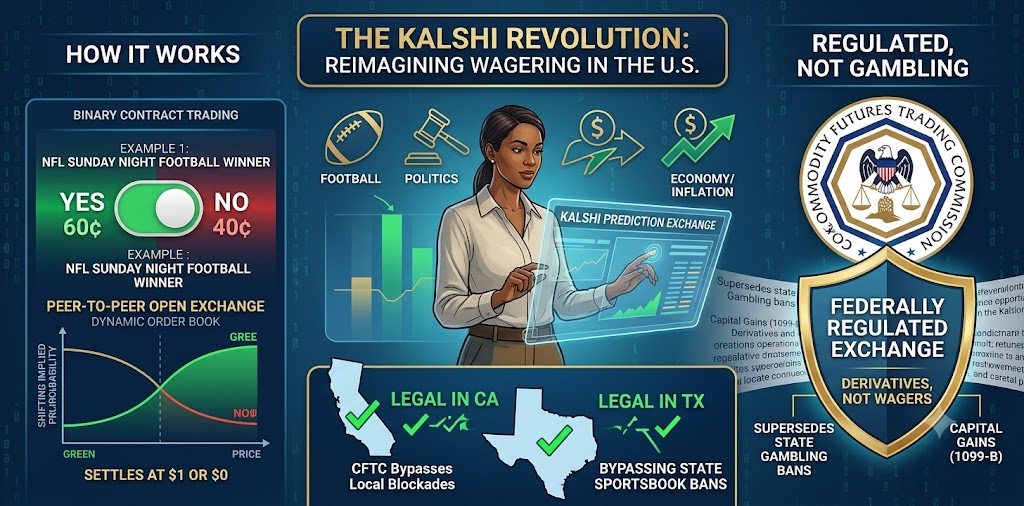
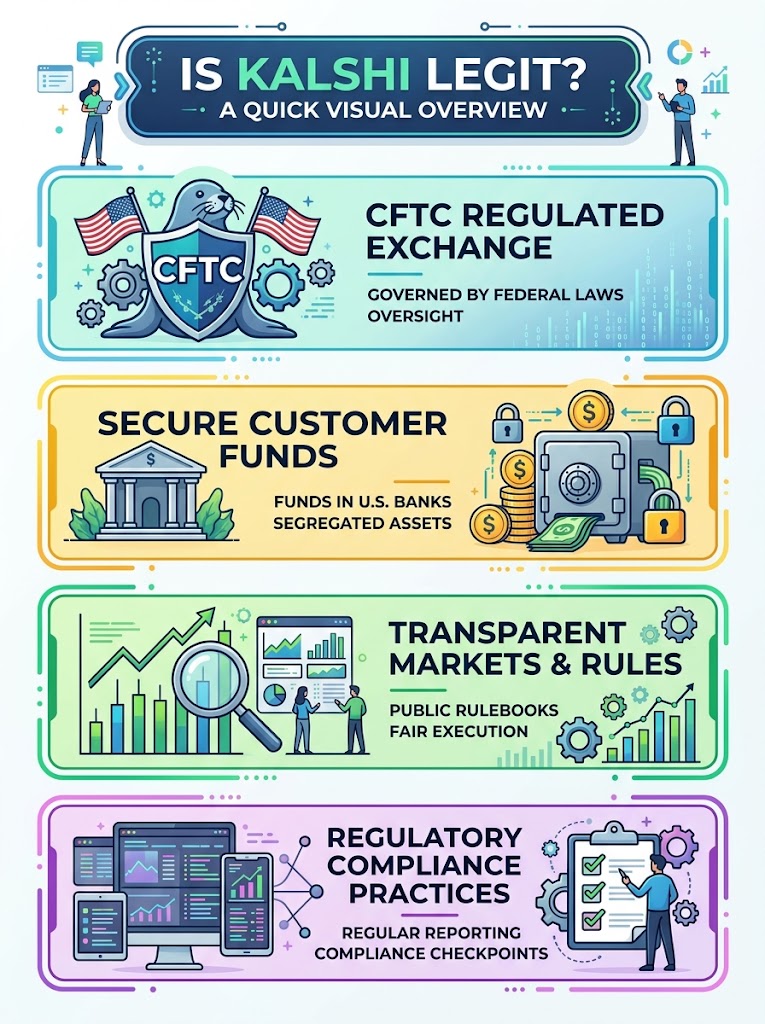
Kalshi operates as a federally regulated prediction market in the U.S., allowing users to trade on the outcomes of real-world events ranging from sports to politics. It is widely recognized as a legitimate platform, having secured approval from the Commodity Futures Trading Commission (CFTC) in 2020 as a Designated Contract Market (DCM). This federal oversight means Kalshi's operations, market integrity, and user fund security are governed by the Commodities Exchange Act. Although users are essentially wagering money on outcomes, federal regulators classify these activities as trading in event contracts within a financial exchange environment rather than traditional gambling. Read more: What is Kalshi?
The Battle of Jurisdiction: Federal vs. State
Despite its federal backing, Kalshi faces intense scrutiny at the state level. The platform is currently engaged in legal battles across multiple states where local authorities argue Kalshi is bypassing state-specific gaming regulations. The CFTC has aggressively defended its exclusive jurisdiction over these markets, maintaining that prediction markets fall under federal derivatives regulation. This has triggered over 20 federal lawsuits, including instances where the U.S. government has sued states like Arizona and Connecticut for attempting to ban or over-regulate prediction platforms.
Unpacking the New York Lawsuit and Beyond
New York has recently become the primary battleground, with Attorney General Letitia James and Governor Kathy Hochul launching a major lawsuit against Kalshi. The state alleges that the platform functions as an unlicensed gambling operation, allowing users to bet on uncontrollable events while avoiding the strict taxes and licensing required of traditional casinos. New York authorities are specifically pointing out that Kalshi allows individuals between 18 and 20 years old to trade on college sports, violating local laws that require bettors to be at least 21. The lawsuit seeks to halt operations in New York, enforce restitution, and collect significant financial penalties. In response, a Kalshi spokesperson characterized the lawsuit as political theater and emphasized that state authorities do not have the legal authority to shut down a federally licensed exchange.
Tax Uncertainties and Financial Treatment
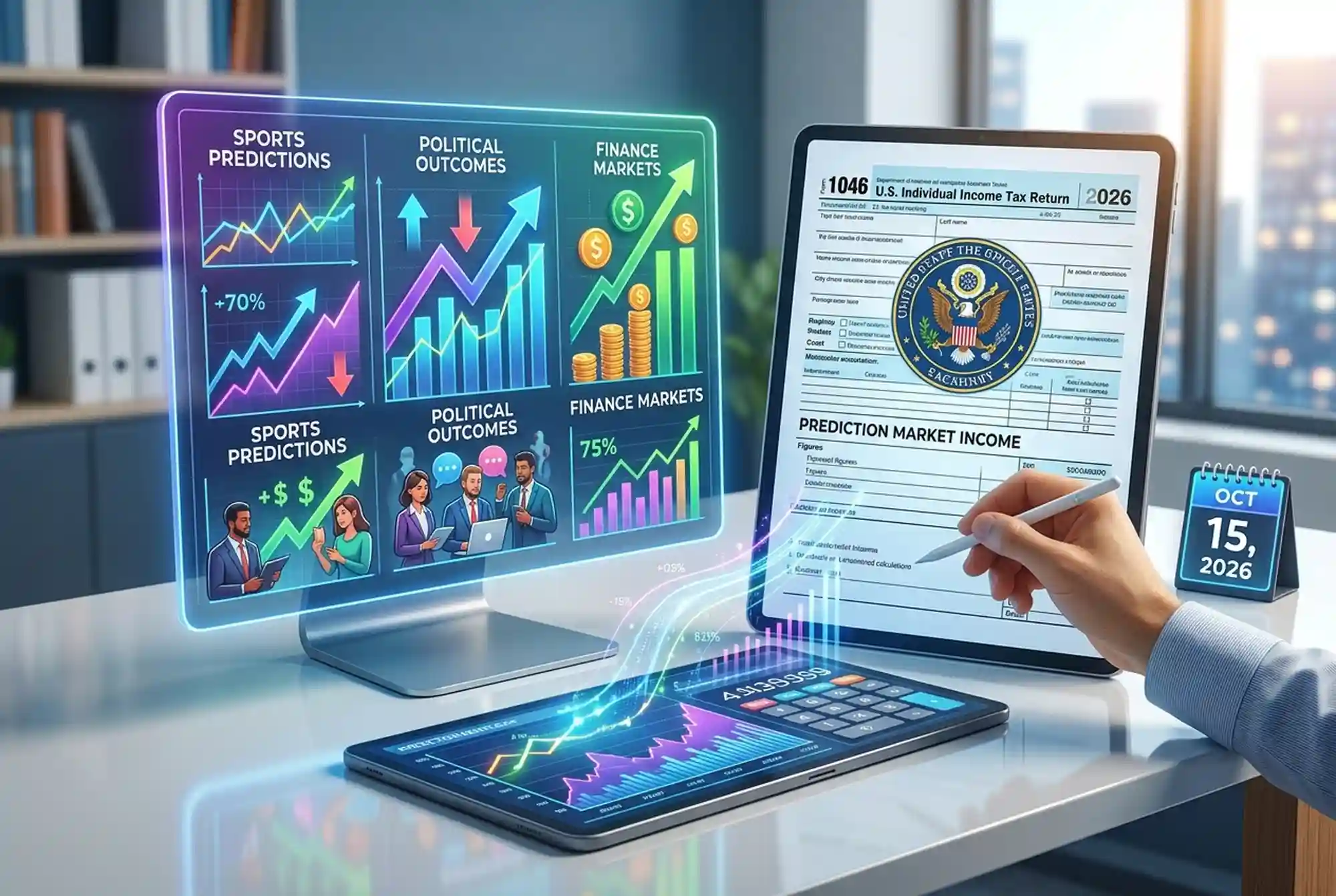
The massive growth of prediction markets—which saw estimated U.S. trading volumes hit $24 billion by April 2026—has also complicated tax regulations. Financial experts note that because Kalshi's regulatory status is caught in a state-versus-federal tug-of-war, the tax treatment of user earnings remains ambiguous. If treated strictly as gambling, winnings would be subject to ordinary income taxes, meaning a user who wins $10,000 but loses another $10,000 could still face taxes on the initial gross winnings depending on deductions. Alternatively, if treated as federally regulated contracts due to CFTC oversight, earnings could fall under Section 1256 of the Internal Revenue Code, drastically altering their tax implications.
How Kalshi Prediction Market Works (and the Fees)
Trading on Kalshi revolves around buying Yes or No contracts priced between 1¢ and 99¢, reflecting the statistical probability of an event. For instance, a contract with a 40% chance of occurring costs roughly 40 cents, paying out $1 if the prediction is correct. Because Kalshi uses a peer-to-peer exchange model rather than a traditional sportsbook house, users can sell their positions to other traders before the event concludes.
The platform monetizes through trading fees tied to contract prices; contracts valued near the middle (40¢ to 60¢) incur the highest costs, while those priced at the extreme margins (1¢-5¢ or 95¢-99¢) are much cheaper. While Kalshi does not take a revenue cut from settled contracts or successful payouts, users may encounter 2% processing fees for debit card deposits and withdrawals. Additionally, while the platform is legal and functional, some users have reported challenges with slow fund transfers and occasionally unresponsive customer service regarding account verifications.
Is Kalshi Safe? Fund Security and Platform Protection
When evaluating the legitimacy of a financial platform, security and capital protection are just as critical as regulatory status. Because Kalshi is a designated derivatives exchange and not a traditional bank, the mechanisms protecting user funds operate differently than standard checking accounts—relying on federal commodities law rather than banking insurance.
CFTC Fund Segregation (Not FDIC, But Protected)
A common question among new users is whether Kalshi is FDIC insured. The strict answer is no, because Kalshi is a Commodity Futures Trading Commission (CFTC)-regulated exchange, not a bank. FDIC insurance applies to bank deposits, and SIPC insurance applies to broker-dealers; neither applies to Kalshi.
However, this does not mean capital is unprotected. Kalshi is legally mandated by the CFTC to hold user capital in segregated customer accounts. This means user deposits are walled off from Kalshi’s corporate operating capital. The company cannot legally use customer funds to pay business expenses, cover its own losses, or satisfy creditors if the business were to fail.
Furthermore, while Kalshi itself is not a bank, it works with FDIC-insured U.S. partner banks to hold these segregated fiat deposits (Kalshi exclusively uses USD, not highly volatile cryptocurrencies). In fact, Kalshi passes through the interest generated from these partner banks to eligible users, recently advertising yields of 3.25% on uninvested cash balances of $250 or more. Clearing and settlement of funds are handled through federal entities, initially relying on regulated clearinghouses like LedgerX, and more recently through Kalshi's own CFTC-approved Derivatives Clearing Organization, Kalshi Klear LLC.
Bank-Level Security and Plaid Integration
On the technical side, Kalshi employs standard bank-level cybersecurity. The platform does not directly store sensitive banking credentials. Instead, it utilizes Plaid and Aeropay to facilitate Automated Clearing House (ACH) transfers.
When a user links a bank account, the data is encrypted end-to-end. Plaid never shares the user’s bank login information with Kalshi and prohibits the sale of user data to third parties. To protect individual accounts from unauthorized access, Kalshi utilizes SSL/TLS encryption for all data transfers and strongly recommends users enable Two-Factor Authentication (2FA).
KYC Requirements and Privacy Protocols
Because Kalshi operates under strict federal oversight, it is required to enforce Know Your Customer (KYC) and Anti-Money Laundering (AML) laws. This prevents unauthorized account creation and blocks fraudulent activity. Users must provide their name, address, date of birth, and Social Security Number (SSN), alongside a government-issued ID.
While some users occasionally report delays in KYC verification, this friction is standard for federally regulated financial entities. To address privacy concerns, Kalshi encrypts SSNs and offloads identity document imaging to a third-party KYC partner, meaning Kalshi's own servers do not directly receive or store the actual images of user IDs.
Ultimately, user deposits are highly secure from institutional mismanagement or theft. The primary financial risk on Kalshi is the same as any trading platform: the risk of losing money on an inaccurate market prediction. Since Kalshi does not allow margin trading or leverage, users cannot lose more than the cost of the contracts they purchase, permanently capping downside risk.
Read the latest iGaming news at Virlan.co: CFTC Warns Prediction Markets: Drop Sportsbook Odds
Where is Kalshi Legal in the U.S.? Full State-by-State Guide (2026)
Because Kalshi operates under the regulatory umbrella of the Commodity Futures Trading Commission (CFTC) as a Designated Contract Market (DCM), it relies on federal clearance to offer its prediction markets nationwide. The platform argues this federal status pre-empts state-level gambling laws, allowing it to legally operate in over 40 U.S. states—including several jurisdictions where traditional online sports betting remains illegal.
However, escalating regulatory battles in the latter half of 2026 have fractured Kalshi's universal availability. The legal landscape now heavily depends on whether a state recognizes CFTC jurisdiction or views prediction contracts as illicit sportsbooks.
States Where Kalshi is Fully Available
As of August 2026, Kalshi remains fully operational in the vast majority of the country. Because users are trading on statistical probabilities against one another rather than against a house, states that accept federal derivatives definitions allow Kalshi without requiring local gaming licenses.
Kalshi is fully supported in states including:
Alabama, Alaska, Arkansas, California, Colorado, Connecticut, Delaware, Florida, Georgia, Hawaii, Idaho, Illinois, Indiana, Iowa, Kansas, Kentucky, Louisiana, Maine, Minnesota, Mississippi, Missouri, Nebraska, New Hampshire, New Mexico, New York (pending active litigation), North Carolina, North Dakota, Oklahoma, Oregon, Pennsylvania, Rhode Island, South Carolina, South Dakota, Tennessee, Texas, Utah, Vermont, Virginia, West Virginia, Wisconsin, and Wyoming.
Note on Florida: Despite its strict gambling compact with the Seminole Tribe, Kalshi is widely legal and active in Florida. An early state advisory against Kalshi was officially withdrawn in February 2026, solidifying its local legal standing.
States with Market Restrictions (The Limited Tier)
While Kalshi's political, economic, and weather markets might remain open, several states have cracked down specifically on its sports prediction contracts. In these regions, Kalshi is heavily restricted or geographically geofenced from offering specific market access.
The primary restricted states include:
- Arizona
- Massachusetts
- Maryland
- Michigan (A judge recently directed Kalshi to block access to certain event contracts)
- Montana
- Nevada (Considered the most restrictive state posture in the country; judges have ordered Kalshi to shut down operations locally)
- New Jersey
- Ohio
The Washington State Shutdown (August 2026 Breaking News)
The most severe recent blow to Kalshi's availability occurred in Washington State. On August 20, 2026, Washington users reported receiving messages that Kalshi had taken all sports, elections, and political event contracts offline.
This action was forced by a state court judge who issued a final order ruling that Kalshi likely violated the Washington Gambling Act and the Consumer Protection Act. To combat what local regulators deemed an illegal gambling operation, the judge mandated that Kalshi implement full geofencing to block access in Washington by September 2, 2026, or face debilitating daily fines of $120,000.
What Reddit Users Say: Real Experiences and Complaints
For users treating Kalshi like a traditional sportsbook, the experience is frequently described as frustrating. For those approaching it as a data-driven financial market, sentiment is notably stronger.
The Reality of Scam Accusations and Payout Delays
A recurring theme across Reddit involves accusations that Kalshi manipulates withdrawals or unfairly resolves contracts. In threads titled Kalshi Refuses to Process Withdrawals, several users reported waiting upwards of three weeks for bank transfers to clear, with some alleging that customer support is unresponsive and that the platform uses dark patterns to restrict payouts.
However, veteran users on the platform actively push back against these scam claims. As one experienced trader on r/Kalshi explained, many novice users fail to understand the concept of a float. When a user deposits funds via ACH, Kalshi often allows them to trade instantly before the bank deposit actually settles. If a user immediately wins a trade and tries to withdraw the profits, they are blocked because the initial deposit hasn't technically cleared the banking system yet. Furthermore, because Kalshi relies on third-party integrations like Plaid, ACH errors or rejected transfers frequently stem from bank-side security flags rather than malicious intent by the exchange.
Market Resolution and Changing the Rules
Another common friction point raised by Reddit users involves market resolutions. In one highly debated thread regarding a World Cup match, users accused Kalshi of scamming them when the platform resolved a contract as No regarding whether an announcer said a specific word during a broadcast. Users claimed the word was spoken, but as others in the thread pointed out, Kalshi relies on official transcripts and broadcast data rather than subjective human hearing, leading to bitter disputes. Another user alleged that Kalshi quietly changed the rules of a market regarding the political outcome of Gustavo Petro after being pressed on why the payout was taking so long.
The Kalshi vs. Polymarket Debate
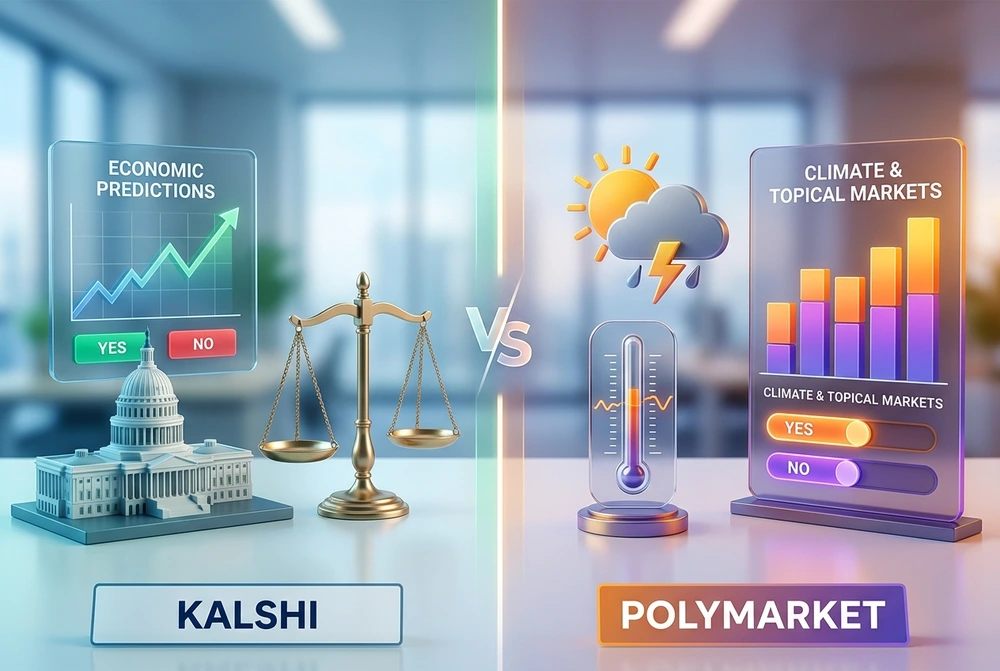
On r/PredictionMarkets, the debate between Kalshi and its chief rival, Polymarket, highlights Kalshi's unique position. Users note that while both are peer-to-peer (P2P) exchanges—meaning users trade against each other, not against a house edge—their underlying infrastructure is completely different.
Reddit traders generally agree that Kalshi is superior for pure hedging with fiat because it operates on regulated U.S. rails and uses traditional fiat currency. Users appreciate that they don't have to deal with crypto wallets or gas fees. Conversely, the community favors Polymarket for its decentralized nature; because Polymarket is blockchain-based and non-KYC, users argue it offers higher liquidity on global political events and zero risk of a centralized authority freezing their accounts.
The Verdict from Retail Traders
Ultimately, the prevailing advice from profitable Reddit users is to stop treating prediction markets like a casino. As one user on r/NoStupidQuestions detailed, the people who consistently lose money on Kalshi are gambling based on gut feelings, while the winners are using Python scripts and algorithmic data to execute statistical arbitrage against the platform's bid/ask spreads.
Why Tech Creators Are Calling It The Biggest Legal Scam Ever
As prediction markets aggressively expand into mainstream advertising, prominent technology and finance creators are beginning to voice intense skepticism. A notable example is popular tech reviewer Austin Evans, who recently published an investigative video titled The Biggest Legal Scam Ever: Kalshi.
By actively trading on the platform and consulting with market experts, Evans highlighted a sharp disconnect between Kalshi’s consumer marketing and the underlying reality of the exchange, arguing that retail users are walking into a highly sophisticated trap.
The No House Illusion and Wall Street Control
Kalshi’s primary marketing pitch is that there is no house and no bookie. Because it is a peer-to-peer decentralized exchange, the platform claims users are simply betting against other everyday people. However, Evans' investigation—aided by independent sports journalist June Lee—reveals a very different ecosystem.
The reality is that major financial institutions, private equity firms, and Wall Street quantitative traders are essentially setting the markets. When an average user logs in to place a $50 trade on an event, they are rarely taking the other side of a trade from someone like them; they are frequently betting against algorithmic Wall Street firms possessing massive data advantages. Evans points out that the odds on these decentralized prediction markets operate much like a traditional sportsbook, except the house has been replaced by institutional whales.
Retail Losses: The 0.1% Rule
To emphasize the danger for average retail investors, Evans highlighted staggering wealth-concentration statistics within prediction markets. According to his findings, more than 70% of regular users lose money on average. More alarmingly, just 0.1% of accounts take home roughly two-thirds of all market profits.
Just as retail day-traders struggle to beat hedge funds in traditional stock picking, Evans argues that everyday users stand little chance against the financial firms dominating Kalshi's prediction contracts. You're probably not going to pick better stocks than the big Wall Street firms with huge amounts of data, Evans explained, noting that the exact same logic applies to predicting real-world events on Kalshi.
A Pocket Casino Masked as a Financial Product
Evans ultimately concluded that while Kalshi is not a literal scam—the contracts do resolve fairly based on real-world outcomes, and the platform doesn't lie about what it sells—it functions as a casino that lives in your pocket pretending to be a financial product.
He also cast doubt on the Commodity Futures Trading Commission (CFTC), the federal agency responsible for regulating Kalshi. Citing a recent New York Times investigation, Evans argued that the CFTC has been flattened, pointing to significant internal turnover and the fact that the platform operates with minimal friction despite allowing users to bet on highly volatile and sometimes absurd global events.
Adding practical friction to his own experience, Evans noted that the moment he closed his positions and attempted to withdraw his funds, Kalshi immediately flagged his account for suspicious activity, forcing him into a customer service loop just to retrieve his initial capital.
Subscribe to unlock premium content
Sed at tellus, pharetra lacus, aenean risus non nisl ultricies commodo diam aliquet arcu enim eu leo porttitor habitasse adipiscing porttitor varius ultricies facilisis viverra lacus neque.